The 1953 Raleigh Sports Tourist I’m in the process of refurbishing
was originally equipped with an enclosed chaincase. Unfortunately; during its previous history
someone removed the lower portion with a hacksaw. Finding an original chaincase complete with
all the parts can be difficult and expensive.
I opted to purchase a repo chaincase from Yellow Jersey; however,
fitting this chaincase to the Raleigh required some careful tweaking (bending) and
patience (maybe a separate article).

There is very little clearance within the chaincase; determining
and setting proper chain line is important to keep the chain from rubbing inside
the case. Chain line is the path the chain follows from the front chainwheel to
the rear sprocket; ideally this path should be parallel with the centerline of
the bike. Proper chain line will minimize
sideward stress on the chain, drive-train noise, and wear. Before
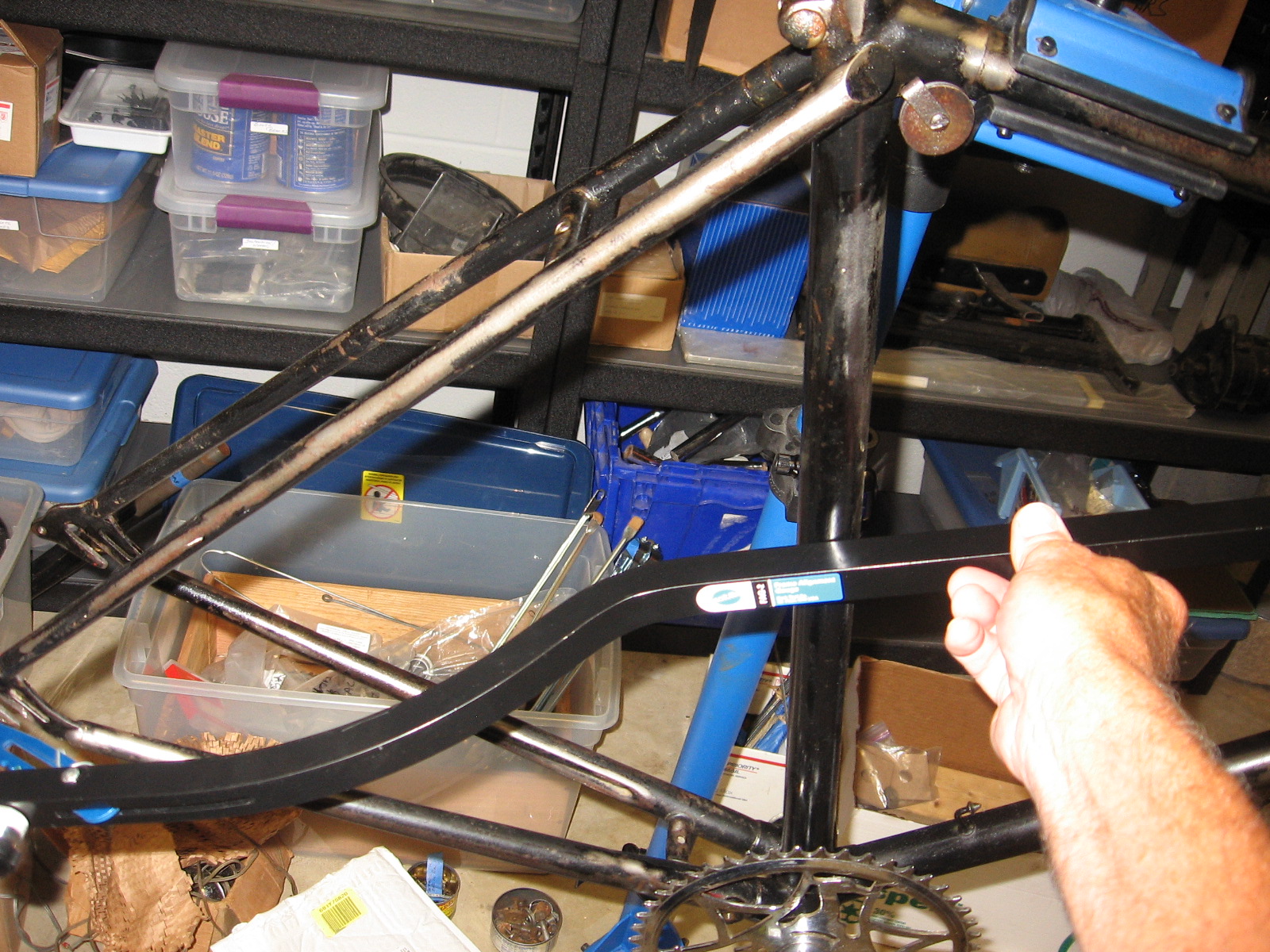
determining the chain line, alignment of the rear triangle to the centerline of
the bike (head tube/seat tube) should be checked and corrected (pic). This will insure that the hub and dropouts
are centered with the frame. This can be
accomplished with an alignment tool or by running a string from one rear
dropout , around the head tube, and back to the other dropout , then measuring
the distance of the string from each side the of seat tube, the distance should
be within a couple of mm of each other.

Determining chain line requires measuring how far the front chainwheel
teeth are from the centerline of the bike (seat tube), then comparing this to
the distance the rear sprocket teeth are from centerline of the AW hub, this
assumes the rear dropouts have been aligned to the centerline of the
frame. To measure the front chain line
measure how far the center of the chainwheel teeth are from the center of the
seat tube. Accurately measuring to the center of the seat tube can be difficult;
I usually measure to the edge of the seat tube, then adding to this ½ the
diameter of the seat tube. In my case
the distance from the chainwheel teeth to the edge of the seat tube was 28.66
mm., The diameter of the Raleigh seat tube measured 28.59 mm, the seat tube
center is 14.3mm (1/2 of 28.59), adding this to this the distance the
chainwheel teeth are from the edge of the seat tube (28.66 mm) results in a
front chain line of 42.96 (14.3 + 28.66).
The rounded front chain line is 43mm.

To determine the rear sprocket chain line requires measuring
the Over-Lock nut Distance (O.L.D.) of the AW hub (pic), dividing by 2 to
determine the hub centerline, then subtracting from this result the distance
the sprocket teeth are from the right hand side axle locknut. It’s
important to note that the O.L.D. can vary among AW hubs depending on how many
spacing washers (Sturmey Archer Part HMW-129), cone lock washers (HMW-147),
cone locknuts (HMN-132) or any other washers, nuts etc. that have been added or
removed from the hub axle during its history.
The O.L.D is only affected by those axle components that reside between
the rear dropouts. Washers, spacers, and
nuts etc. on the outside of the dropouts do not affect the O.L.D.. According to original Sturmey Archer service
manuals the AW hub was delivered from the factory with one cone locknut and one
spacing washer on the left hand side. On
the right hand side there should be one cone locknut, one cone lock washer, and
no spacing washers. In this configuration
the O.L.D. from the factory was 4-5/16” or 109.5 mm. This is why most 3-speed rear dropout spacing
is 110mm. In addition to being able to
adjust the AW hub O.L.D. by adding/removing spacers, the position of the sprocket
on the axle can also be changed.
Assuming the sprocket is a reversible (dished) three spline type, it can
be flipped to move the sprocket teeth inward or outward as necessary by
approximately 3mm. The three spline sprockets
are retained by a sprocket circlip (HSL-721), and two sprocket spacing washers
(HMW-127). Each sprocket washer is
approximately 1.6 mm thick. Both can be
position on either side of the sprocket, or one on each side to move the sprocket
in increments of 1.6mm along the axle.
You must always use two spacing washers so the circlip will properly seat
in the driver groove securing the sprocket in place. Reversing the sprocket or rearranging the
sprocket washers will not change the O.L.D. but will change the rear chain line.

Before rebuilding the 1953 AW hub I noted the original
location of all spacing washers, locknuts and washers and sprocket orientation. In my case, the hub had spacing washers
(HMN-129) located on both sides of the axle; normally there is only one located
on the left side; normal cone locknuts on both sides; and normal cone lock
washer on the right. The dish of sprocket
was located inward with spacing washers (HMW-127) on either side. This configuration resulted in a O.L.D of
113.36 mm (pic). I then measured the how
far the centers of the sprocket teeth were from the right side locknut, the
distance was measured to be 18.70 mm.
The rear chain line can now be calculated as ½ of the O.L.D. less the
distance of the sprocket teeth from the right side lock nut. 113.36/2 – 18.70 = 37.98, or rounded to
38mm. This represents how far the rear
cop teeth are from the centerline of the frame.
Comparing the rear chain line of 38mm, to the previously calculated front
chain line of 43mm shows the rear chain line needs to be moved outward 5 mm.

In order to accomplish this, I removed the extra spacing
washer (HMW-129) from the right side of the hub axle, this moved the chain line
approximately 2.5mm to the right, I also reversed the sprocket so the teeth
were oriented outward by approximately 3 mm, I did not change the original location
of the sprocket spacing washers, one on each side of the sprocket. After these changes the O.L.D. now measured
110.40 mm, and the sprocket teeth were now 12.03 mm from the right side locknut. Re-calculating the new rear chain line
resulted in 110.40/2 - 12.03 = 43.17, rounded to 43mm, now matches the front
chain line. In actual practice adjusting
the AW chain line is not nearly as complicated describing it in writing.
The original steel rims and spokes on the 1953 Raleigh were
rusted beyond use. I will be replacing
the rims with alloy Sun CR18’s rims and stainless steel spokes. Now that I have established the final O.L.D.
for the rebuilt AW hub, I can order the proper length spokes, since the hub O.L.D.
is one input required for most spoke length calculators.
Please share your thoughts and experiences.

 Posts
Posts